Is it too late to start research in your final year of medical school?
So you're in your final year, applications are coming, and you've got no papers. Honestly, it isn't too late, but you can't afford to waste a month. Here's how to sharpen the axe before you swing it: learn the method, keep your tools simple, and pick the kind of research that gives the most value for your hours.
Key takeaways
- No, it isn't too late to start research in your final year, as long as you choose a project you can finish and learn the method first. A systematic review and meta-analysis needs no patients or lab, and with a clear method the hands-on work fits into about five months at roughly five hours a week.
- Sharpen the axe first. A month spent learning the method feels slow, but it's what makes the next four smooth. Most students go straight to cutting, and that's where the months disappear.
- Use as few tools as you can. Every new program is another learning curve, and every hand-off between programs is an export, a clean-up and a chance to change a number by mistake.
- Pick research with the most value per hour. Meta-analyses were the most-cited study design in a JAMA analysis and case reports the least, while randomised trials took a median of about 4.8 years from first enrolment to publication.
- Submitted isn't published. ERAS lets you list a paper as Submitted, Accepted/In-Press or Published, so give it its true status and be ready to discuss it at interview.
- In India, a prospectively registered systematic review no longer needs to go to an ethics committee (ICMR, February 2024), but surveys, chart reviews and trials still need committee review before they start.
Is it too late to start research in your final year?
No, it isn't too late, as long as you choose a project you can finish and learn the method before you start. A systematic review and meta-analysis needs no patients and no lab, and with a clear method the hands-on work fits into about five months at roughly five hours a week. What you can't afford is to spend the first two months working out how.
Here's the honest picture first:
- Most students who want to do research never publish it
- Submitted isn't published
- Final year still leaves you time
Most students who want to do research never publish it: In a review of 79 studies, about 72% of medical students were interested in research and around 31% took part where it wasn't compulsory, but on average only 13% of student research led to a first-authored paper (Amgad et al., 2015). In a survey of first-year students in Chennai, 79% named lack of time as a barrier (Omprakash et al., 2019). Starting late is normal. Starting late without a plan is what fails.
Submitted isn't published: Once you submit, the journal sets the pace. Across studies of biomedical journals, the median time from submission to publication ranged from 70 to 558 days (Andersen et al., 2021). So plan to submit well before your application goes in, and list the paper with the status it really has (more on that below).
Final year still leaves you time: In India, the internship after your final exam lasts at least twelve months (NMC internship regulations, 2021), so a review you start in final year can be submitted, revised and published while you're an intern.
Why do most students run out of time?
Because they start cutting with a blunt axe. They pick a topic and start searching on day one, then lose months redoing steps they didn't know how to do: a question that was too broad, a search they had to rebuild, an extraction sheet that didn't fit the data.
There's an old lumberjack's saying, often wrongly credited to Abraham Lincoln: if you have five minutes to cut down a tree, spend three of them sharpening your axe. The earliest version anyone has found comes from a 1944 talk by an Oklahoma pastor quoting an unnamed lumberjack, and Lincoln's name was first attached to it in a 1960 advert (Quote Investigator).
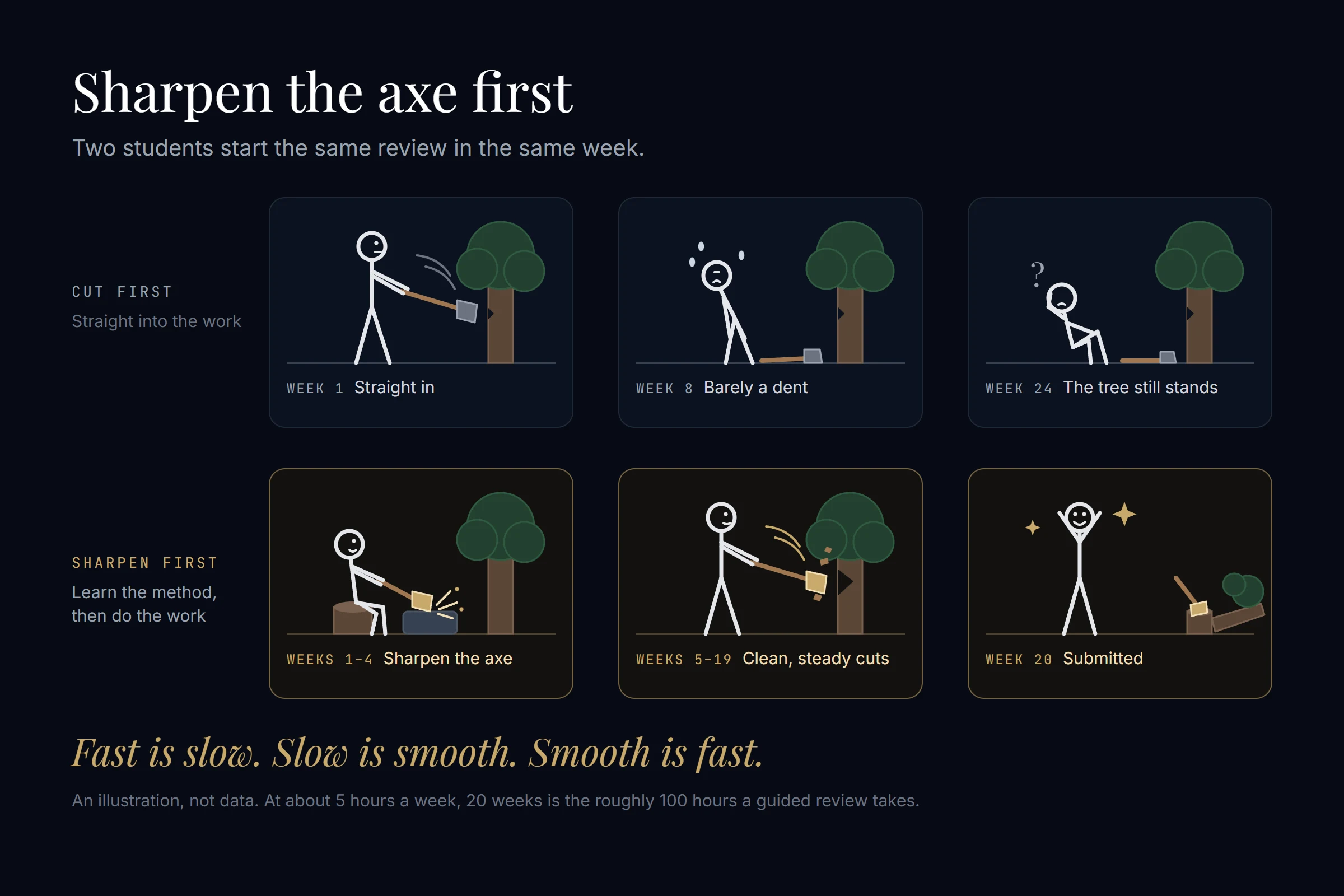
As we like to say, fast is slow, slow is smooth, and smooth is fast. It's a saying from military training, and nobody has traced who said it first; the earliest print use we could find is from 2006 (Wiktionary). The idea is simple: rushing causes mistakes that cost more time than the rush saved, while careful, practised steps get quick.
The research on how long reviews take says the same thing. It depends hugely on who's doing them:
- Typical teams take over a year
- A commercial team in the 1990s took over 1,000 hours
- An expert team with automation took two weeks
Typical teams take over a year: Registered systematic reviews took 67.3 weeks on average from their start date to publication, with a typical team of five, and the range ran from 6 to 186 weeks (Borah et al., 2017).
A commercial team in the 1990s took over 1,000 hours: 37 meta-analyses by one company took a mean of 1,139 hours each, and about half of that went on searching, retrieving papers and building the database (Allen and Olkin, 1999).
An expert team with automation took two weeks: Four experienced researchers finished a full systematic review in 12 calendar days, about 61 person-hours, using automation tools (Clark et al., 2020). That's not a target for a first review, but it shows what skill and good tools do to the clock.
What does sharpening the axe mean in research?
It means learning each step of the project you're about to do before you do it, so that you do each step once. For a systematic review and meta-analysis, these are the skills that save the most time:
- Framing a narrow question: one population, one intervention or exposure, one comparison and one outcome (PICO for short), narrow enough to finish. In our experience, a question that's too broad is the single biggest time sink.
- Writing and registering a protocol: your plan, written down and registered before you search. In India, registering it also means you don't need to submit the review to an ethics committee (ICMR, 2024).
- Building a search: a search string you can run, record and rerun, so that nobody can say you missed the obvious studies.
- Screening with a second reviewer: two people deciding independently which records meet your criteria, then settling the disagreements.
- Extracting data with a tested sheet: a form you try on two or three studies before you use it on all of them.
- Judging risk of bias: rating how far each study's design and conduct could have skewed its results, with tools such as RoB 2 for trials.
- Running the meta-analysis: choosing the effect measure and model, and knowing when not to pool at all. The guide to meta-analysis software covers the tools.
- Reporting it: writing the paper to PRISMA 2020, the reporting checklist for systematic reviews.
The guide to doing a systematic review as a medical student walks through each of these in order. Sharpening isn't the same as collecting courses, though. One of us spent thousands of dollars on workshops and courses in medical school and still didn't get published. The sharpening that counts is learning each step well enough to do it, and then doing it. If you'd like structured lessons, Tau Square Academy's free Phase 0 (14 short lessons) and Advanced Fundamentals (11 lessons, including choosing a study design and when to pool data) cover the foundations.
Two habits make the learning stick:
- Learn by doing
- Protect short, regular blocks
Learn by doing: Before you run your own meta-analysis, reproduce a published one: take a recent review's data and rerun its forest plot. It's the pottery-class lesson: you learn by making pots, not by reading about clay.
Protect short, regular blocks: One of us splits research days into two-hour creative and execution blocks, and plans by the week rather than the day, so a missed evening doesn't derail the month (here's how that works).
Why does using fewer tools save time?
Because every new program is another thing to learn, and every hand-off between programs costs time and invites mistakes. A typical student review can run through eight tools, from PubMed to Word, and each one has its own learning curve.
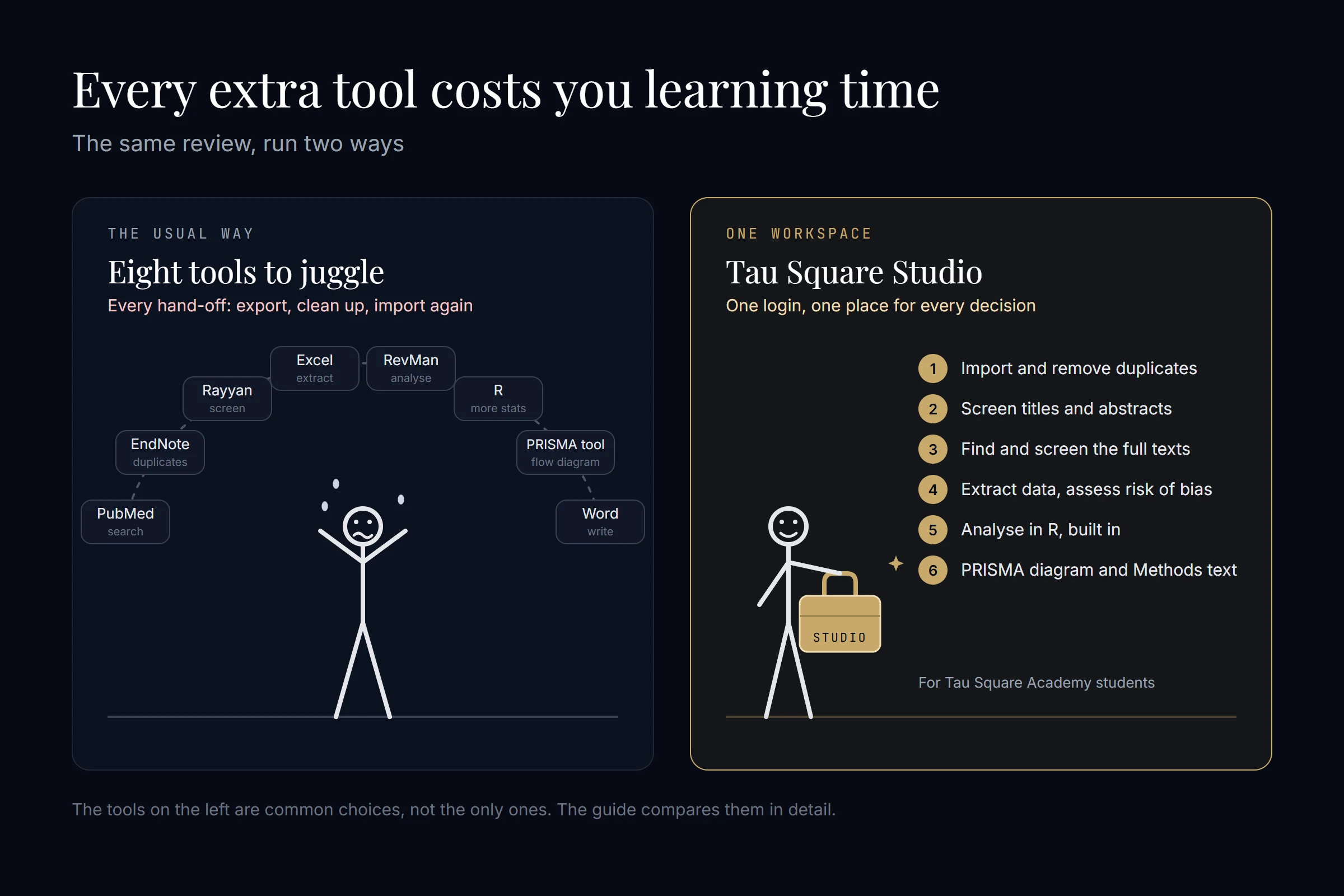
Juggling tools costs you in three ways:
- A learning curve for each program
- An export and import at every hand-off
- A chance of error every time you retype a number
A learning curve for each program: A reference manager, a screening tool, a spreadsheet layout and an analysis program means four first weeks instead of one.
An export and import at every hand-off: Records move from the database to the reference manager to the screening tool, and each move means exporting, fixing the format and checking nothing was lost. Even removing duplicates differs between tools: at default settings, EndNote and Zotero missed more duplicates than Rayyan or Covidence in one comparison (McKeown and Mir, 2021).
A chance of error every time you retype a number: The Cochrane Handbook counts moving data into analysis software without retyping it as an advantage of electronic forms, because every retyped value is a chance to change it (chapter 5).
So keep the chain short: choose tools that cover several stages, and learn them once. The guide to the best meta-analysis software compares the options, from Covidence and EPPI-Reviewer for screening and extraction to R for the analysis. Tau Square Studio, made by Tau Square Academy for its students, runs every stage in one workspace, from importing records to the analysis in R and the PRISMA diagram (Tau Square Studio).
Which research gives the most value for your time?
A systematic review and meta-analysis gives the most value for the least time. It needs no patients or lab, it sits at the top of the traditional evidence pyramid, and meta-analyses were the most-cited study design in a JAMA analysis of health research (Murad et al., 2016; Patsopoulos et al., 2005). Here, value means where a design sits in that pyramid and how often it gets cited.
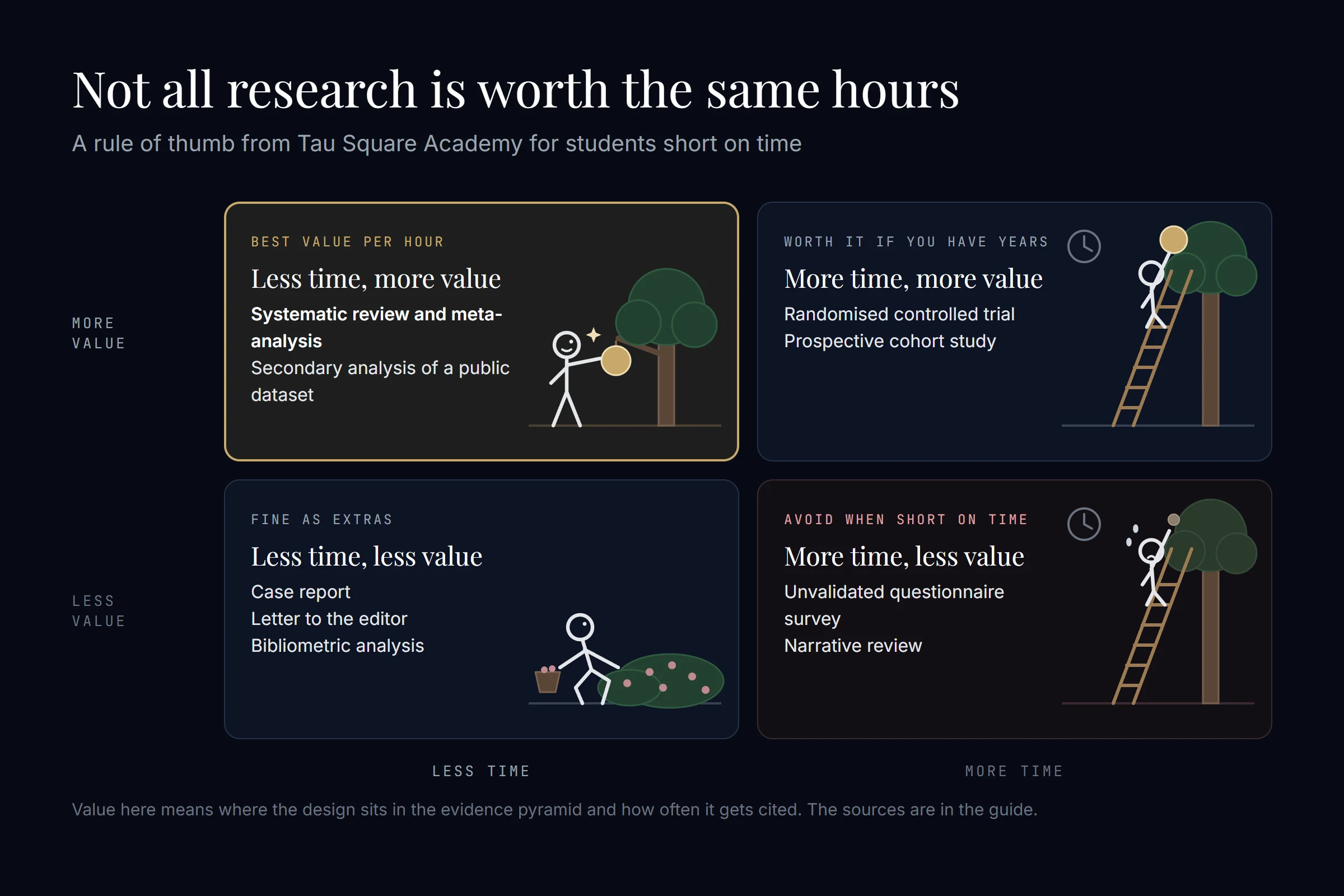
Every project sits somewhere on two scales, how long it takes and how much it's worth, which gives four boxes:
- Less time, more value: systematic reviews and meta-analyses, and secondary analysis of a public dataset.
- More time, more value: randomised controlled trials and prospective cohort studies.
- Less time, less value: case reports, letters to the editor and bibliometric analyses.
- More time, less value: unvalidated questionnaire surveys and narrative reviews.
When time is short, work in the first box, use the third for extras, and stay out of the fourth. Here's what's in each.
Less time, more value: systematic reviews and public datasets
Systematic review and meta-analysis: A systematic review finds and appraises every study on a narrow question, using a method you register in advance, and a meta-analysis pools their results into one estimate. Meta-analyses were cited more than any other design: of those published in 2001, 43.6% got more than 10 citations within two years, against 29.5% of randomised trials and under 1% of case reports (Patsopoulos et al., 2005). In India, a prospectively registered review doesn't need to go to an ethics committee (ICMR, 2024). The catch is their popularity: about 80 systematic reviews were being published every day by 2019 (Hoffmann et al., 2021), so check that your question hasn't already been answered before you commit to it.
Secondary analysis of a public dataset: analysing data someone else has already collected. In the US, NHANES releases its public-use files on its website, under a data user agreement but with no application (CDC; NCHS data user agreement). MIMIC-IV, an intensive-care database, asks for more: a human-subjects research course, a signed data use agreement and, for students, a supervisor's name, with approval taking several business days (PhysioNet; MIMIC). It's real original research, but you need to be confident with statistics, and in India your ethics committee still decides whether the project is exempt, because the 2024 ICMR addendum covers only registered systematic reviews (ICMR guidelines, 2017).
More time, more value: trials and prospective cohorts
Randomised controlled trial: participants are randomly assigned to different treatments, which puts trials just below systematic reviews in the evidence pyramid (Murad et al., 2016). Across 165,135 trials, the median time from enrolling the first participant to publication was about 4.8 years (Showell et al., Cochrane 2024). In India, a trial needs ethics approval and registration with the Clinical Trials Registry of India before its first participant is enrolled (ICMR, 2017; Rao et al., 2018).
Prospective cohort study: following a group forward in time to see who develops an outcome. The follow-up is the study, so it takes as long as the outcome takes to happen, and in a study of small projects at one medical school, prospective ones took longer to reach publication than retrospective ones (Tumin et al., 2022).
Both are worth doing if you have years and a team. If someone is already running one, joining it is a good way in. Starting one in your final year usually isn't.
Less time, less value: case reports, letters and bibliometric analyses
Case report: a write-up of one patient with something genuinely unusual, following the 13-item CARE checklist (Gagnier et al., 2013). It's quick if you have the case and the patient's consent, but case reports were the least-cited design in the JAMA analysis, with a median of 0 to 1 citations in two years (Patsopoulos et al., 2005). Many case-report journals also charge publication fees: DOAJ lists maximums of US$2,990 at Journal of Medical Case Reports and US$660 at Radiology Case Reports, both with waiver policies (September 2026).
Letter to the editor: a short reply to a paper a journal has published. It's quick to write and keeps you reading the literature closely, but it's a small contribution.
Bibliometric analysis: counting papers and citations on a topic with software. It's fast, and that's the problem: more than 1,500 were published in the health sciences in 2022 alone, and they averaged 1.78 citations a year each (Li et al., 2024). A 2026 editorial in an orthopaedics journal criticised the flood of low-effort ones (Vaishya et al., 2026).
These are fine as extras alongside a main project, but they're not a substitute for one.
More time, less value: homemade surveys and narrative reviews
Unvalidated questionnaire survey: a questionnaire you've written yourself and haven't tested to show it measures what it claims (that testing is called validation). In India, it still needs ethics committee review before you collect a single answer, and ICMR sets no fixed turnaround for that review (ICMR, 2017). Then come weeks of chasing responses, and at the end, without validation, it's hard to show your questions measured what you meant.
Narrative review: a review where you choose which papers to discuss, without a systematic search. It can take as much reading as a systematic review, but without a protocol nobody can check what you left out, and non-systematic reviews had about half the odds of a meta-analysis of being highly cited (Patsopoulos et al., 2005).
What does a five-month plan look like?
One step a month at roughly five hours a week: learn the method in month 1, then plan, screen and extract, and submit at around week 20. In Tau Square Academy's guided method, a review takes about 100 hours of work, which is where these numbers come from.
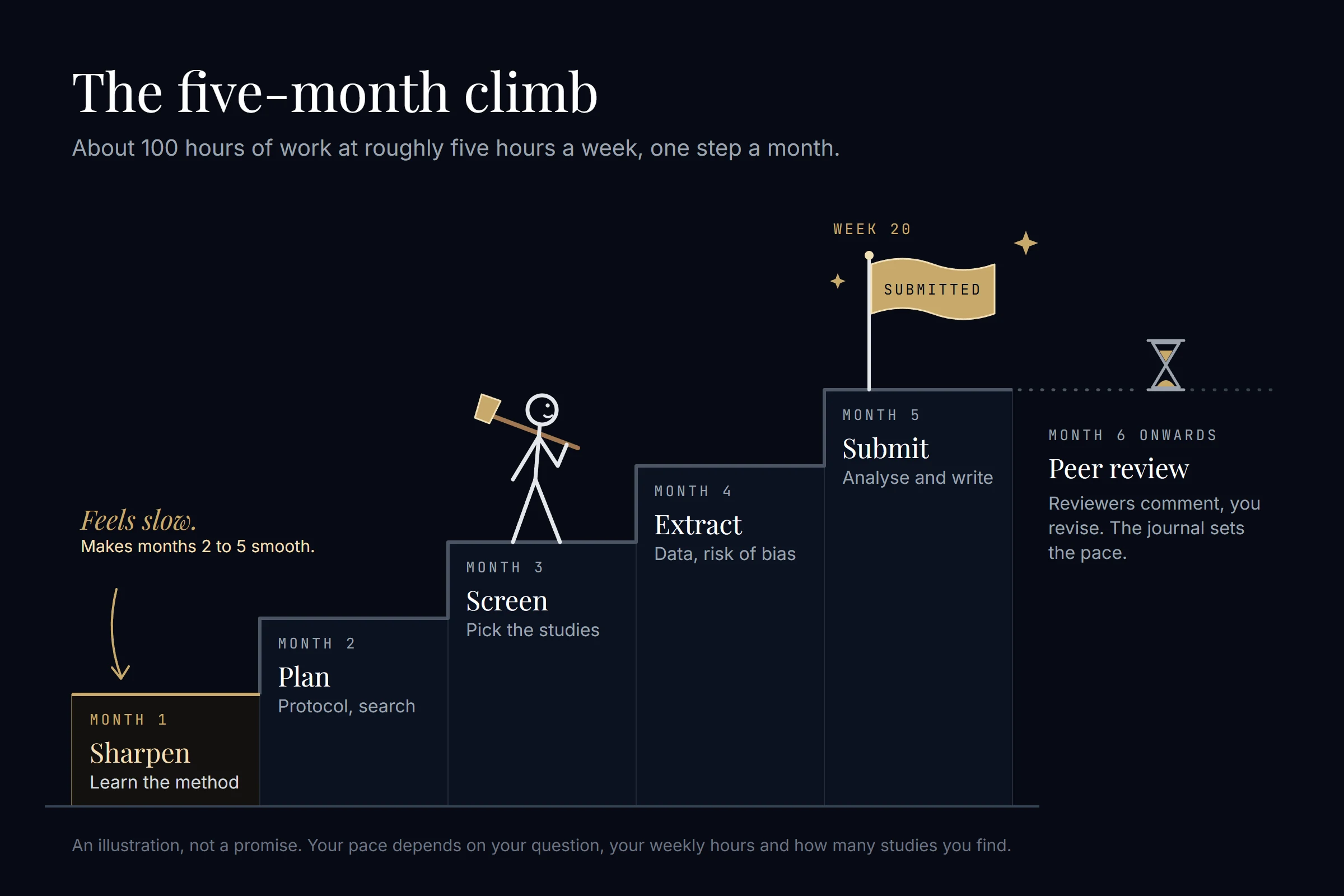
Here's what each month involves, and how you know it's done:
| Month | What you do | You're done when |
|---|---|---|
| 1 (weeks 1 to 4) | Learn the method; choose a question and narrow it; search PROSPERO and PubMed for existing reviews | You have one narrow question that nobody has answered recently |
| 2 (weeks 5 to 8) | Write the protocol and register it on PROSPERO or OSF; build and run your search | Your protocol is registered and your search results are exported |
| 3 (weeks 9 to 12) | Remove duplicates; screen titles and abstracts, then full texts, with a second reviewer | You know your included studies and your PRISMA numbers |
| 4 (weeks 13 to 16) | Extract data on a tested sheet; assess risk of bias in pairs | Your data sheet is checked and locked |
| 5 (weeks 17 to 20) | Run the meta-analysis; write the paper to PRISMA 2020; submit | It's submitted |
From month 6, peer review takes over. Two things help while you wait:
- Expect months, not weeks
- Consider a preprint
Expect months, not weeks: Median times from submission to publication ranged from 70 to 558 days across studies of biomedical journals (Andersen et al., 2021), and part of the wait comes from journals publishing in issues, a print-era habit that creates backlogs (Björk and Solomon, 2013). Start the next project while you wait.
Consider a preprint: medRxiv is a free archive for health research papers that haven't been peer reviewed yet; each one gets a DOI when it's posted and can't be removed later (medRxiv). At the median, the journal version appeared 199 days after the preprint (Manganaro, 2024), so a preprint makes your work public months earlier. Check your journal's policy on preprints first, and tell the journal you've posted one (ICMJE).
Does a submitted paper count on your residency application?
Yes, if you label it honestly. For the US Match, the 2027 ERAS application lists research under "Scholarly Work", and each journal article carries one of three statuses: Submitted, Accepted/In-Press or Published, with no "provisionally accepted" option (MyERAS user guide). There's no limit on the number of entries, and you can mark up to three as "Most Meaningful" (AAMC).
Three things decide how much a paper helps you:
- Its status when programs read your application
- Whether every entry is accurate
- Whether you can talk about it
Its status when programs read your application: In the 2027 season, applicants could submit from 2 September 2026, and programs could start reviewing applications on 23 September 2026 (AAMC timeline). Check the dates for your own season; if they're similar, a review started in November and submitted by April has months of peer review behind it by September. Status matters later too: in one study of orthopaedic applicants, 90.7% of papers listed as accepted were later confirmed as published, against 63.4% of those listed as submitted (Lemme et al., 2020).
Whether every entry is accurate: ERAS requires complete and accurate information, and the AAMC investigates discrepancies, with confirmed cases reported to interested parties (AAMC). Never list a submitted paper as accepted. If you're unsure how to label something, the MyERAS guide points you to your Designated Dean's Office.
Whether you can talk about it: If it's on your application, expect questions at interview about its design, its results and what comes next (AMA, 2024). A review you did yourself, step by step, is easy to talk about.
Applying somewhere other than the US? The publishing guide covers what counts in other systems.
What mistakes cost final-year students the most time?
Starting a review that someone has already done costs the most. After that come skipping the protocol, underestimating ethics review, and filling your last months with projects that are quick but count for little.
- Not checking for an existing review first: search PROSPERO and PubMed before you commit to a question. Why: about 80 systematic reviews were being published every day by 2019, and some topics already have more than 20 meta-analyses (Hoffmann et al., 2021; Ioannidis, 2016).
- Skipping the protocol to save time: register it before you screen. Why: in India, a prospectively registered review doesn't need to go to an ethics committee at all (ICMR, 2024), and a registered protocol is what shows reviewers you didn't change your plan after seeing the results.
- Starting a survey or chart review without time for ethics review: submit to your institution's ethics committee first, and ask when it meets. Why: ICMR's guidelines say all health research involving people or their data must be reviewed by an ethics committee before it starts, and that the committee, not you, decides whether a project is exempt (ICMR, 2017).
- Filling your last months with case reports: one is fine if you have a genuinely unusual case, but five won't replace a review. Why: case reports were the least-cited design in the JAMA analysis, and many case-report journals charge publication fees (Patsopoulos et al., 2005).
- Listing a submitted paper as accepted: use the status it actually has. Why: ERAS requires accurate information, and the AAMC investigates discrepancies (AAMC).
Frequently asked questions
Is it too late to start research in final year of medical school?
No, if you choose a project you can finish and learn the method first. A systematic review and meta-analysis needs no patients or lab, and with a clear method the hands-on work can fit into about five months at roughly five hours a week. Peer review then adds months, so submit well before your application goes in and list the paper with its true status.
How long does a systematic review take?
Longer than most students expect. Registered systematic reviews took 67.3 weeks on average from their start date to publication, with a typical team of five (Borah and colleagues, BMJ Open 2017), and the range was 6 to 186 weeks. With a clear method, the hands-on work can fit into about 100 hours, roughly five months at five hours a week, before peer review.
Can I list a submitted paper on ERAS?
Yes. In the 2027 MyERAS application, journal articles and abstracts in the Scholarly Work section carry a status: Submitted, Accepted/In-Press or Published. There's no provisionally accepted option. List each paper with its true status, because the AAMC investigates inaccurate applications, and be ready to discuss anything you list at interview.
What is the fastest research to publish as a medical student?
Case reports and letters to the editor are the quickest to write, but they count for little: case reports were the least-cited study design in a JAMA analysis, and fewer than 1% were cited more than 10 times in two years. A systematic review and meta-analysis takes longer but gives far more value for the time, and it needs no patients or lab.
Does a systematic review need ethics approval in India?
Not if it's prospectively registered. Since February 2024, ICMR says a systematic review or meta-analysis that follows standard guidelines and is registered in advance, for example on PROSPERO or OSF, doesn't need to be submitted to an ethics committee. Cite the ICMR addendum in your paper's ethics statement, and check whether your college or target journal still asks for a letter.
Did Abraham Lincoln say 'Give me six hours to chop down a tree'?
There's no evidence he did. Quote Investigator traced the saying to a 1944 talk by an Oklahoma pastor quoting an unnamed lumberjack, who said that with five minutes to cut down a tree, he'd spend three sharpening his axe. Lincoln's name was first attached in a 1960 advert, and the six-hour version has no dated source at all.
What does 'slow is smooth, smooth is fast' mean?
It means careful, practised steps end up quicker than rushed ones, because rushing causes mistakes you then have to fix. It's a saying from military training, often credited to the US Navy SEALs, though nobody has traced who said it first. In research, it's the case for learning the method before you start, so that you do each step once.
Ready to start? Phase 0 is free: 14 short lessons, no card needed. If you’d rather talk first, a doctor from our team will map your next three steps on a free 15-minute call.
Start Phase 0 free or book a free callTau Square Academy Research Team
A team of doctors, research mentors and educational psychologists
Written and fact-checked by the Tau Square Academy research team: the team of doctors, research mentors and educational psychologists who designed the 100-Hour Research Protocol and teach every cohort. Every fact links to its source, and we update guides when things change.