Where can I publish my medical paper?
You've got a paper, or you're close. Where it goes matters more than most students think: the wrong journal can make good work count for nothing for jobs, residency or promotion. Here's how to choose, in the order we'd do it.
Key takeaways
- Publish in a peer-reviewed journal that takes your type of paper, is indexed where your paper needs to count, passes a ten-minute legitimacy check, and charges a fee you can pay, or none at all.
- What counts depends on where you're headed: India's NMC counts four paper types in journals indexed in listed databases, the UK's IMT scores papers with a PubMed ID, and ERAS lists any peer-reviewed article. A journal in MEDLINE or PubMed Central meets every indexing rule.
- Find candidates in your own reference list and with a free journal finder, then shortlist three: a reach, a match and a safe journal.
- Check indexing at the source (the NLM Catalog, Scopus or DOAJ) and reach the journal's website through the index, never through an invitation email.
- Submit to one journal at a time: ICMJE says the same manuscript must not go to two journals simultaneously.
- Many good journals charge nothing to publish. Open-access fees are where the cost is, and some journals and publishers offer waivers.
Where can I publish my medical paper?
In a peer-reviewed journal that passes four tests: it publishes your type of paper on your topic, it's indexed where your paper needs to count, it's legitimate, and its fee is one you can pay (or there isn't one). Most students only check the first. The other three are where good papers end up counting for nothing.
These are the four tests, and where each is covered below:
- It fits your paper: topic, article type and word limits (finding journals that fit).
- It counts where you're going: India, the US Match or UK training (what counts).
- It's real: not predatory, and not a hijacked copy of a real journal (the ten-minute check).
- You can afford it: plenty of good journals charge nothing to publish (fees).
Which journals count for jobs, residency and promotion?
It depends on where you're headed, and the rules are more specific than most students realise. A journal indexed in MEDLINE or PubMed Central meets every indexing requirement below, which makes it the safest default when you don't yet know where your career will take you.
| Where you're headed | What counts | Source |
|---|---|---|
| India: MD/MS final exam | One research paper published or accepted as first author in a journal of your specialty (or a poster or podium presentation at a national, zonal or state conference) | PGMER-2023, regulation 5.2(x) |
| India: medical college faculty jobs and promotion | Original papers, meta-analyses, systematic reviews and case series in journals indexed in Medline, PubMed Central, the Science Citation Index, Embase, Scopus or DOAJ (or journals NMC specifies). Case reports aren't on the list | NMC faculty regulations 2025, applicable from 30 June 2025 |
| US: residency applications (ERAS, 2027 season) | Peer-reviewed journal articles, journal abstracts and book chapters, plus oral and poster presentations. Submitted, accepted and published papers can all be listed, and a PMID is optional | AAMC: Scholarly Work |
| UK: Internal Medicine Training (2027) | Up to 6 of 30 shortlisting points for a PubMed-cited original research paper as first, joint-first or corresponding author. A paper without a PMID scores 1 point at most | IMT application scoring |
| UK: Core Surgical Training (2027) | A first-author paper cited in PubMed or Web of Science (not a case report or letter) is one route to the top grade in one portfolio domain | CST portfolio guidance |
Two things follow from this table:
- Indexing comes before impact factor
- The type of paper matters as much as the journal
Indexing comes before impact factor: None of these rules asks for an impact factor. They ask whether the journal is indexed in named databases or, in the UK, whether your paper has a PMID (the PubMed ID number). A modest journal in MEDLINE counts in places where a better-known one outside those databases doesn't.
The type of paper matters as much as the journal: NMC's faculty definition leaves out case reports, and from 2027 the UK's IMT no longer counts letters or abstracts as PubMed-cited "other" publications (IMT, July 2026). If you're choosing what to write next, a systematic review or an original study counts in more places than a case report. These rules change, so check the current version for your own route before you rely on them.
How do I find journals that fit my paper?
Start from the journals that already publish work like yours, then narrow them down to three. Do it in this order:
- Mine your reference list
- Run a journal finder
- Read three recent papers in each candidate
- Check the article types and limits
- Shortlist three: a reach, a match and a safe journal
Mine your reference list: Count where your references were published. Any journal that appears three or more times already publishes your topic, and its editors know the debate your paper joins. It's the strongest lead you have, and it takes five minutes.
Run a journal finder: Paste your title and abstract into one and it suggests journals that have published similar work. JANE compares your text with millions of PubMed records and marks which suggested journals are in MEDLINE and DOAJ. It also warns that predatory journals can turn up in its results, so the checks below still apply. Publishers' own tools only suggest their own journals: Elsevier's JournalFinder (no account needed), Springer Nature's Journal and funding finder, Wiley's Journal Finder and the Taylor & Francis Journal Suggester. Use JANE plus one publisher tool.
Read three recent papers in each candidate: If yours wouldn't look at home next to them, in topic, method and size, move on. It's the quickest way to avoid a desk rejection (a rejection by the editor before the paper ever reaches peer review).
Check the article types and limits: Open the journal's instructions for authors. Does it publish your type of article at all? Many journals don't take case reports, and some don't publish systematic reviews. Then check the word limit, the abstract format, the reporting guideline it expects (PRISMA 2020 for a systematic review) and whether it wants the protocol registered.
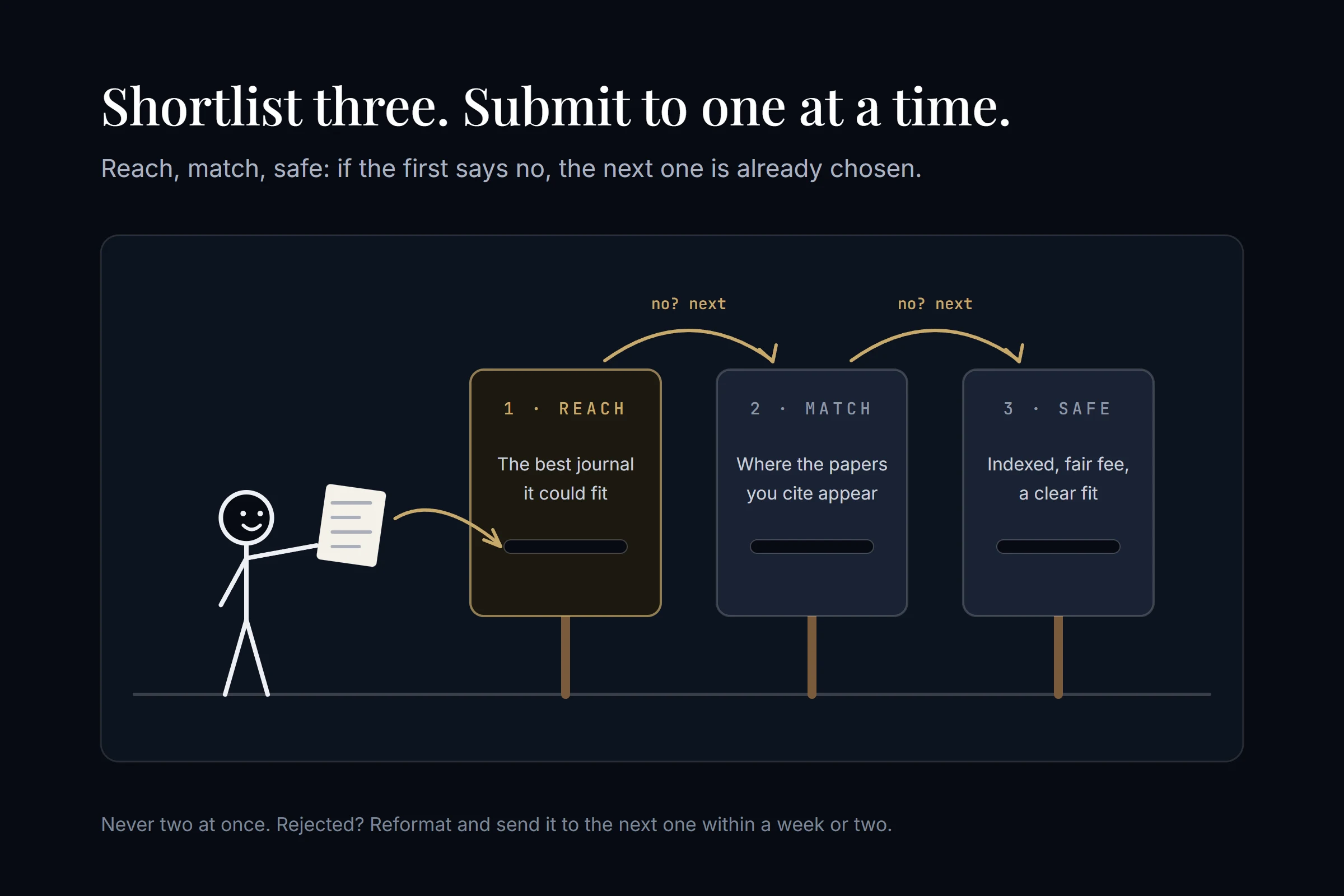
Shortlist three: a reach, a match and a safe journal: The reach is the best journal your paper could plausibly fit. The match is a journal from your reference list. The safe one is indexed, fairly priced and an obvious fit for your topic. Submit to the reach first. If it says no, the next journal is already chosen, so you aren't restarting the search while you're disappointed.
Student-only team? Look for double-anonymous review
In double-anonymous peer review (also called double-blind), reviewers don't see who wrote the paper. In a controlled experiment at a computer-science conference, reviewers who could see author names were more likely to recommend papers from famous authors and top institutions (Tomkins et al., 2017). That was one conference, not a medical journal, but if nobody on your team has a well-known name, a journal that hides names takes the question off the table.
Journals state their model on their peer review policy page: PLOS ONE, for example, uses single-anonymised review (PLOS ONE), while the International Journal of Medical Students uses double-masked review (IJMS). A journal's DOAJ record also lists its review type.
Where can I publish a case report, systematic review or letter?
Each type of paper has its own usual homes, and its own value later. These are the four most students write:
- Systematic reviews and meta-analyses
- Original research
- Case reports
- Letters to the editor
Systematic reviews and meta-analyses: Most specialty journals publish them, and so do the large general open-access journals. They count under every rule in the table above. Before you submit, check that the journal expects PRISMA 2020 and a registered protocol, and that it hasn't just published a review on your exact question (the systematic review guide covers how to check a topic is still open).
Original research: Specialty journals are the natural home, from international titles to national and regional ones. Every journal will ask for your ethics committee approval (or the reason none was needed) and for the reporting checklist that matches your design, such as STROBE for observational studies.
Case reports: Many journals don't take them, so journals dedicated to case reports are the usual home, and their costs differ a lot. Three that students often ask about, checked on 2 November 2026:
| Journal | Indexed for MEDLINE? | Cost to publish | Worth knowing |
|---|---|---|---|
| BMJ Case Reports | Yes (NLM) | The corresponding author must be a Fellow: £393 or US$767 a year as an individual, nothing extra if your institution holds a fellowship. Open access is optional (BMJ) | A student corresponding author must copy the lead clinician on all correspondence, and consent forms signed only by students aren't accepted (BMJ). No waivers |
| Journal of Medical Case Reports (BMC) | Yes (NLM) | £1,160 or US$1,775 for a case report (Springer Nature) | Waiver requests from India are considered case by case, at submission |
| Cureus | No, but every article is deposited in PubMed Central, so it appears in PubMed (NLM) | About 20% of articles are published free; the rest need paid "Preferred Editing", averaging about $400 (Cureus) | Clarivate removed it from Web of Science in October 2025, so it has no impact factor (Retraction Watch) |
Before you choose a case report, look back at the first table: NMC's faculty rules don't count case reports at all, and the UK's IMT scores one as an "other" publication, worth fewer points than original research.
Letters to the editor: A short response to a recently published paper, usually sent within weeks of it appearing. A letter is a fine first taste of the process, but it counts for little: NMC's faculty definition doesn't include letters, and the UK's IMT stopped counting them as PubMed-cited publications for 2027.
How do I check a journal is legitimate in ten minutes?
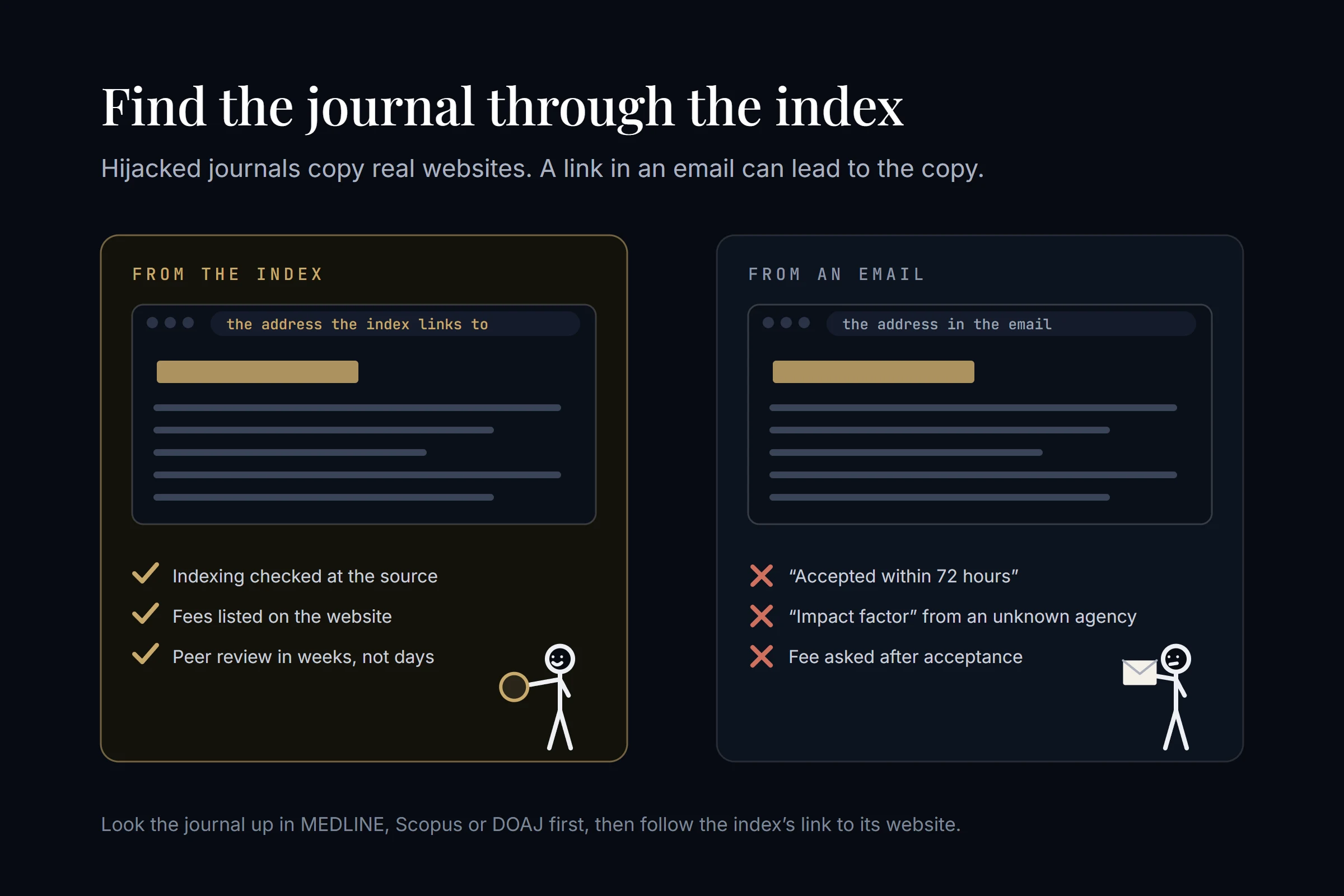
Check the journal at the source, not on its own website. A predatory journal (one that takes fees without real peer review or editing) will claim anything on its homepage, and a hijacked journal (a fake website copying a real journal's name) can look identical to the real one. These six checks take about ten minutes:
- Confirm the indexing at the source
- Reach the website through the index
- Run the Think. Check. Submit. checklist
- Look for COPE membership
- Find the fee before you submit
- Distrust speed
Confirm the indexing at the source: Look the journal up in the NLM Catalog and read its "Current Indexing Status". NLM itself says an article appearing in PubMed doesn't necessarily mean its journal is in MEDLINE or PubMed Central (NLM FAQ). For Scopus, search the free Scopus sources list, which needs no sign-in; Elsevier also publishes a list of discontinued titles every month (Elsevier). For an open-access journal, search DOAJ, which only accepts journals that follow good publishing practice and removes those that stop (DOAJ).
Reach the website through the index: Hijacked journals copy a real journal's title, ISSN and other details onto a fake website. Follow the journal's link from its NLM Catalog or DOAJ record instead of a link in an email, and look the title up in the Retraction Watch Hijacked Journal Checker.
Run the Think. Check. Submit. checklist: The checklist asks what an experienced author would: whether you or your colleagues know the journal, whether you can contact the publisher, and whether it's clear about its peer review and its fees. If most answers are no, choose another journal.
Look for COPE membership: The Committee on Publication Ethics lists its member journals and publishers in its member directory. Membership is a good sign, not a guarantee, and a missing entry isn't proof of a problem: COPE notes that some publishers don't list all their journals.
Find the fee before you submit: A real journal states its fee, or that there isn't one, on its website before you submit. A fee that appears only after acceptance is a warning sign.
Distrust speed: Real peer review takes weeks at the least. A promise of acceptance within days, or of "guaranteed" publication, suggests the paper won't be properly reviewed.
- Trusting "indexed in Google Scholar": Google Scholar lists almost anything that looks scholarly. Why: it isn't a curated index, so it proves nothing about quality and counts under none of the rules above.
- Treating an article in PubMed as proof: Articles reach PubMed by more than one route. Why: only the NLM Catalog tells you whether the journal itself is currently indexed for MEDLINE.
- Submitting through an invitation email: An unsolicited "call for papers" that flatters your earlier work. Why: it's how predatory and hijacked journals usually find authors. If the journal interests you, look it up in an index and start from there.
- Trusting an unfamiliar metric: A "global impact factor" or "journal score" from an agency you can't identify. Why: the Journal Impact Factor comes only from Clarivate's Journal Citation Reports, and none of the career rules above asks for one anyway.
Do I have to pay to publish my medical paper?
No. Many good journals charge nothing to publish, because libraries pay subscriptions to read them instead. The fee you hear about is the article processing charge (APC): open-access journals charge it so the paper is free for everyone to read. In top medical journals the median APC is roughly $2,900 (Tocco et al., 2025), and it varies a lot between journals.
Some examples, from each journal's own page on 2 November 2026 (all are indexed for MEDLINE):
| Journal | Fee to publish open access |
|---|---|
| BMJ Open | £2,535, plus GST for authors in India (BMJ Open) |
| Scientific Reports | £2,290, US$2,850 or €2,490, plus local taxes (Scientific Reports) |
| Journal of Medical Case Reports | £1,160 or US$1,775 for a case report (Springer Nature) |
There are three ways to publish without paying an APC:
- Choose a subscription or hybrid journal
- Look for an open-access journal with no fee
- Ask for a waiver at submission
Choose a subscription or hybrid journal: Many specialty journals still publish under a subscription model, where publishing costs you nothing. Hybrid journals let you choose whether to pay for open access, so read the fee page carefully before you assume there's a charge.
Look for an open-access journal with no fee: Some open-access journals charge authors nothing, and a journal's DOAJ record shows whether it charges an APC. The International Journal of Medical Students, for example, charges no submission, processing or publication fees (IJMS) and is listed in DOAJ. It isn't in MEDLINE, though, and it doesn't routinely deposit papers in PubMed Central (IJMS), so check that it counts for your route: NMC's list includes DOAJ, but the UK's IMT wants a PMID.
Ask for a waiver at submission: Most automatic waivers follow World Bank income groups, and India doesn't qualify for them. It isn't in either Research4Life group, Springer Nature's full waivers and 50% discounts go to other countries (Springer Nature), and BMJ's full waivers are for low-income countries (BMJ). What's left is case by case: BMJ considers partial discounts of up to 50%, Springer Nature considers requests made at submission, and in a Springer Nature pilot authors in India pay 25% of the usual fee at 64 journals, most of them BMC titles (Springer Nature). Students outside India should check their own country on each publisher's list.
Can I submit to two journals at once, and how long does it take?
No. ICMJE's recommendations say authors should not submit the same manuscript "simultaneously to more than one journal", in any language (ICMJE). Submit to one journal, wait for its decision, and move to the next on your shortlist only if it says no or you formally withdraw.
A few things make the wait shorter and the next step faster:
- Check the journal's own timeline
- Consider a preprint
- Have the next submission ready
Check the journal's own timeline: Many journals publish their median time to a first decision on their website. A desk rejection usually comes quickly; a full peer review takes weeks to months. The publishing guide has typical timelines across biomedicine.
Consider a preprint: A preprint is your manuscript posted publicly before peer review, so others can read and cite it while journals decide. medRxiv takes original research and systematic reviews with a meta-analysis, but not case reports, narrative reviews or papers a journal has already accepted (medRxiv). Springer Nature and BMJ don't treat a preprint as prior publication, but ICMJE warns that one "may influence a journal's interest", so read your target journal's preprint policy before you post.
Have the next submission ready: Most papers are rejected at least once. Read the reviewers' comments, fix what's fair, reformat for the next journal on your list and send it within a week or two. If it's a systematic review, the guide to why systematic reviews get rejected covers what reviewers push back on.
Frequently asked questions
Is PubMed indexed the same as MEDLINE?
No. MEDLINE is the National Library of Medicine's selective index of journals, while PubMed also includes articles that reach it by other routes, such as deposits in PubMed Central. NLM itself says an article appearing in PubMed doesn't necessarily mean its journal is in MEDLINE or PMC. To check a journal, open its NLM Catalog record and read the Current Indexing Status. India's NMC counts both MEDLINE and PubMed Central journals.
Can I submit my paper to two journals at the same time?
No. ICMJE's recommendations say authors should not submit the same manuscript, in any language, simultaneously to more than one journal. Submit to one, wait for its decision, and only then send it to the next journal on your shortlist, or formally withdraw it first. Choosing three journals in advance (a reach, a match and a safe one) keeps the wait from costing you extra time.
Do I have to pay to publish a medical paper?
No. Many journals charge nothing to publish because readers' libraries pay subscriptions. Open-access journals charge an article processing charge, with a median of roughly $2,900 in top medical journals (Tocco et al., 2025), and some open-access journals charge nothing, such as the International Journal of Medical Students. Authors in India rarely qualify for automatic waivers, but BMJ and Springer Nature consider requests case by case.
How do I know if a journal is predatory?
Check it at the source, not on its own website. Confirm its indexing in the NLM Catalog, Scopus or DOAJ; reach its website through that index rather than an email; check the title in the Retraction Watch Hijacked Journal Checker; run the Think. Check. Submit. checklist; look for COPE membership; and be wary of acceptance promised in days or a fee that appears only after acceptance.
Is Cureus indexed in PubMed, and does it count?
Cureus isn't indexed for MEDLINE, but every article is deposited in PubMed Central, so its papers appear in PubMed with a PMID (NLM Catalog, November 2026). That means they meet India's NMC indexing list and the UK's IMT requirement for a PMID. Clarivate removed Cureus from Web of Science in October 2025, so it has no impact factor. About 20% of its articles are published free.
Where can a medical student publish a case report?
Usually in a journal dedicated to case reports. BMJ Case Reports is indexed for MEDLINE but needs the corresponding author to hold a fellowship (£393 a year individually, as of November 2026). Journal of Medical Case Reports is in MEDLINE and charges £1,160 for a case report. Remember that NMC's faculty rules don't count case reports, and the UK's IMT scores them below original research.
Does a paper in a journal not indexed in PubMed count for residency?
For the US Match, yes: ERAS lists peer-reviewed journal articles, and a PMID is optional. For UK Internal Medicine Training it barely counts, because a paper without a PMID scores 1 of the 6 publication points at most. For Indian faculty posts, the journal must be indexed in Medline, PubMed Central, the Science Citation Index, Embase, Scopus or DOAJ, or specified by NMC.
Ready to start? Phase 0 is free: 14 short lessons, no card needed. If you’d rather talk first, a doctor from our team will map your next three steps on a free 15-minute call.
Start Phase 0 free or book a free callTau Square Academy Research Team
A team of doctors, research mentors and educational psychologists
Written and fact-checked by the Tau Square Academy research team: the team of doctors, research mentors and educational psychologists who designed the 100-Hour Research Protocol and teach every cohort. Every fact links to its source, and we update guides when things change.