Execution breeds leverage.
What happens when medical students are given institutional-grade methodology and permission to fail fast.
The Graduated Physician
The Starting Point
A graduated physician with the clinical training to treat patients — but none of the methodological training to contribute to the science behind that treatment. He wanted to do meta-analysis. He had zero experience with the methodology and no structured guidance anywhere he looked. Like most physicians, he had been taught to consume research, never to produce it.
What Changed
He stopped looking for shortcuts and learned the actual framework — phase by phase. He executed each step independently, hit walls, corrected, and repeated the loop until the method became his own. Not memorised. Internalised.
Twelve Months Later
He completed comprehensive training across meta-analysis, research methodology, and scientific writing — and put it to work immediately. A research project he conceived, executed, and completed entirely on his own was accepted for presentation at Digestive Disease Week (DDW) 2026 — one of the largest gastroenterology meetings in the world.
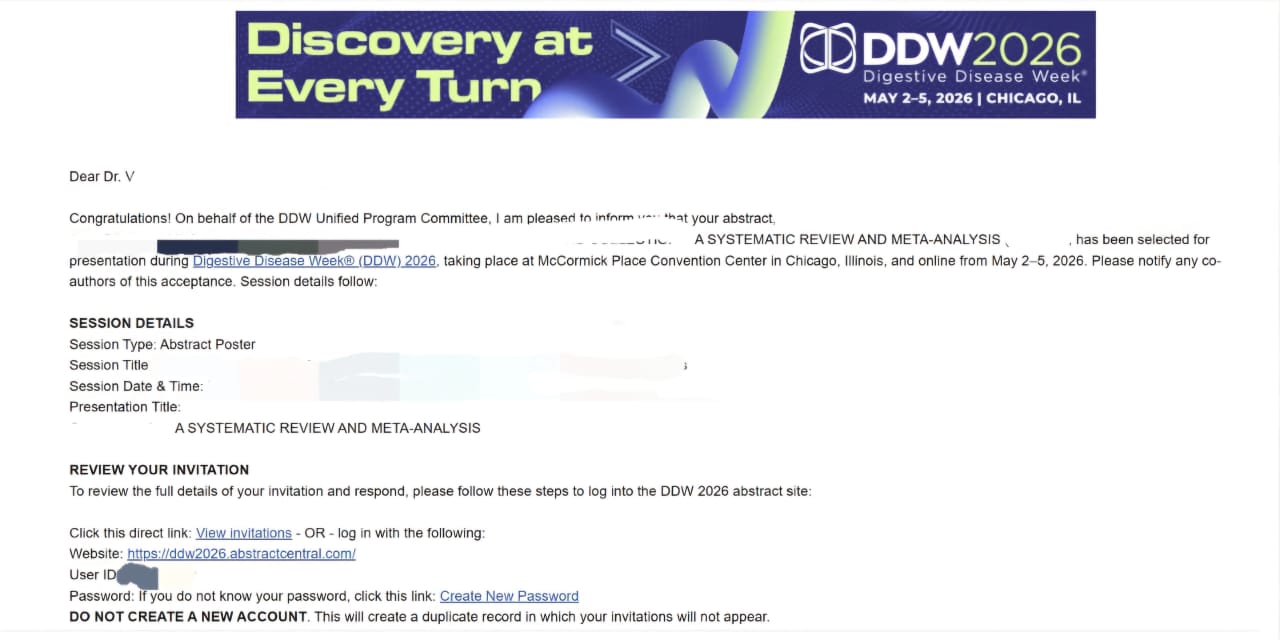
But the acceptance wasn't the real outcome. The real outcome was that he no longer needed anyone's permission or supervision to do high-quality research. That independence compounded — into multiple peer-reviewed publications, international research collaborations, invitations to serve as a peer reviewer, and active consideration for research opportunities in the United States.
He didn't get a paper. He became a researcher.
The Third-Year Who Was Going Nowhere
The Starting Point
She was a third-year medical student when she first reached out — full of drive, with no direction to point it at. She did everything she was told to do. She approached professor after professor. She chased opportunity after opportunity. Each conversation ended the same way: vague encouragement, a promise to circle back, and silence.
Months passed. She had the ambition to build a research career and the work ethic to earn one — but no one had ever shown her the actual path. She was going nowhere, and she knew it.
What Changed
At Tau Square, she stopped waiting for a mentor to hand her a project and learned to build one herself. She mastered the computational engine — the part most students never touch. When she hit a complex statistical model she couldn't crack alone, she deployed Doubt Tokens and got the exact intervention she needed at the exact point she was stuck. No waiting. No vague advice. A fix.
The Outcome
Her first-author meta-analysis was submitted to a Q1 journal. She presented her findings — independently, as the presenting author — at a major international surgical conference, the American Society of Breast Surgeons (ASBrS). And she has since received invitations to serve as an expert peer reviewer.
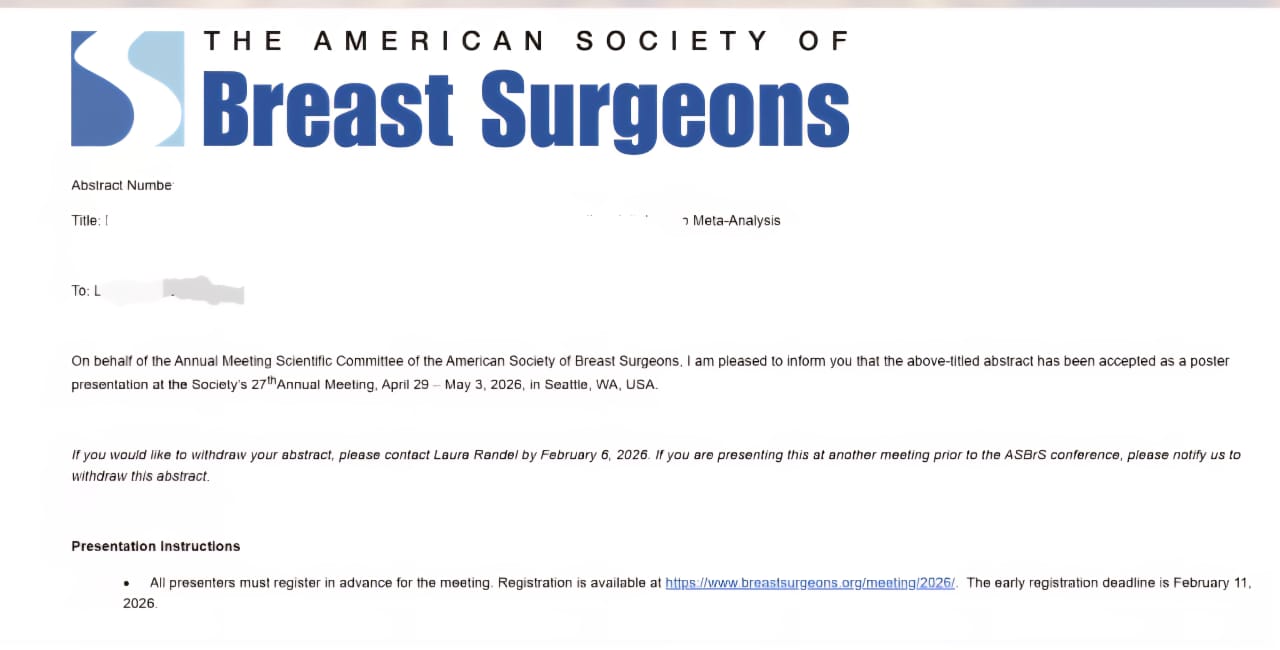
The same student who couldn't get a single professor to give her a real chance now stands on an international stage presenting her own work.
Nothing about her changed except one thing: someone finally showed her how.
Both end on the same quiet truth — the transformation wasn't talent, luck, or connections. It was access to a method that should have been taught from the start.
That's the entire thesis of Tau Square in two human stories. K.V. proves it works for graduated physicians starting from zero. L.S. proves it works for students the system left behind.